A Review of Genesis by Bernard Beckett
By Gary Gregg, PhD
McConnell Center Director
What does it mean to be human? In one way or another almost every great piece of literature–from Homer's Odyssey to Shakespeare's Hamlet to Tolkien's Lord of the Rings–asks this basic question. Few authors are as overt in their raising this question than is Bernard Beckett in his 2006 novel Genesis (Mariner Books).
I recently picked up this slim volume because a friend suggested it as a modern companion to Plato's Republic.
Though what I found in the pages was not at all what I had expected
from the description given, I did find a good read that raises profound
questions for our age of the machine and the growing science of
genetics. And, the final twists of the plot were worth every moment.
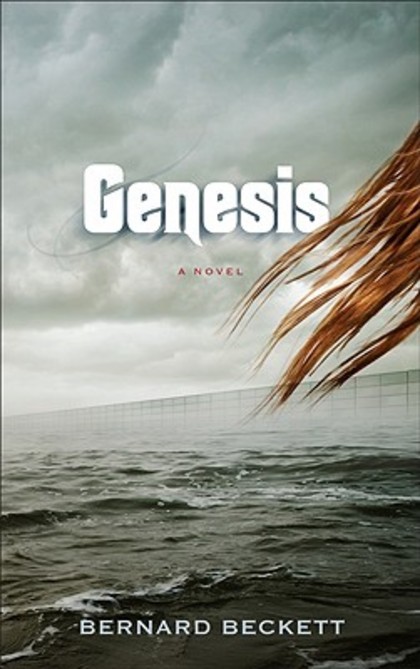 The book takes place in a post-apocalyptic age. A plague has decimated
the population of the planet except for a small island-nation led by a
man who calls himself Plato. Plato builds a sea wall to protect his
people from the carriers of the plague and then proceeds to build a
society remarkably like the Republic that sprang from the imagination of
the great Greek thinker 2,500 years ago. The Republic's motto is
"Forward toward the past" and its version of conservatism manifests
itself in the platonic vision that change means decay. The classes of
society are divided into philosophers, soldiers, technicians and
laborers.
The book takes place in a post-apocalyptic age. A plague has decimated
the population of the planet except for a small island-nation led by a
man who calls himself Plato. Plato builds a sea wall to protect his
people from the carriers of the plague and then proceeds to build a
society remarkably like the Republic that sprang from the imagination of
the great Greek thinker 2,500 years ago. The Republic's motto is
"Forward toward the past" and its version of conservatism manifests
itself in the platonic vision that change means decay. The classes of
society are divided into philosophers, soldiers, technicians and
laborers.
The key moment in the downfall of the Republic comes with the discovery
that the laboring class would be the key source of instability. To deal
with this situation, the leaders reason, they must do away with labor so
no human being finds themselves at the bottom. To that end, they build
labor- saving machines and continue in their experiments to perfect
their machines by making them capable of artificial intelligence.
But if a machine can be developed with artificial intelligence–with the
ability to learn, mimic, change and evolve as it interacts with its
environment (like human babies interacting with their parents), what
sets it apart from being considered a human being? This, perhaps, is the
key question of the novel and unfolds as a series of interactions
between a robot dressed as an orangutan and a human rebel whose crime
was to save an innocent girl adrift on the sea by killing one a fellow
soldier who, under orders, was about to kill her.
Beckett wrote the novel while he was on a science fellowship exploring
DNA mutations and one can see the application he was making of applying
our understanding of DNA to that basic question of what makes us human.
What does make us human? Is it being self-conscious? Being able to
imagine and create? Being created in the image of God? Suffering from
Original Sin? Having a soul? A certain particular pattern in our DNA?
Amidst all we can do with machines, is there something that is
ultimately non-transferable from our species?
In 1948, Richard M. Weaver published a book called Ideas Have Consequences. In
that important book, Weaver showed the origins of modernity and also
gave us a very handy phrase with which to understand the power of ideas.
In Genesis, Beckett gives us a short novel whose basic thrust is
to imaginatively demonstrate his conception of the incredible power of
ideas. Ideas, one of his characters argues, are all that hold us
together. They bind person to person into communities. But, what is
more, rather than understanding ideas to be the creations of individual
human beings, he creates a picture of ideas as being outside forces
which invade and colonize individual minds. They are like microbes
transmitted from host to new brain, occasionally mutating in order to
survive in their new environment.
What if being human, Beckett seems to want us to ask, is just to have
been colonized by a certain set of particular ideas? What if those ideas
are best expressed, perhaps, in the first book of the Bible which
Beckett takes for his own title? What if, then, those ideas can jump
from organic intelligence to colonize artificial intelligence, too? Or,
what if those ideas, like all living things, can die away in a culture
that neglects them or actively assaults them?
Genesis is a slim volume and worth the time, thought and reaction
it might provoke. In our age no less than any other and perhaps more,
we must continue to seek wisdom about what it means to be human.
Gary L. Gregg II is the author or editor of ten books including his young adult novels The Sporran and The Iona Conspiracy.

